COMET: Controllable Long-Horizon Motion Generation
Corresponding Author · WACV 2026
Summary
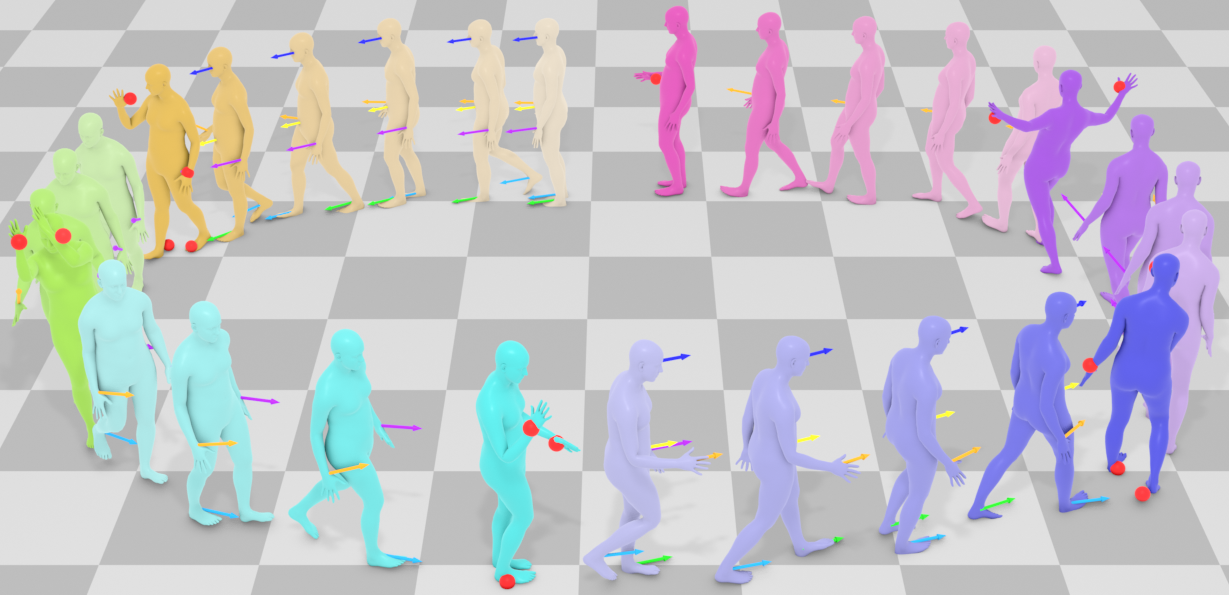
COMET is a real-time autoregressive framework for stable long-horizon character motion with fine-grained control over arbitrary user-specified joints. Its Transformer-based conditional VAE supports goal-reaching and in-betweening in a single model, while reference-guided feedback prevents accumulated error and enables plug-and-play style transfer. Evaluations show high-quality real-time motion and stronger performance than state-of-the-art methods on complex control tasks. (Lee et al., 2026)
Challenge
Long-horizon character motion must remain stable while responding to controls that can change across time and body joints. Existing goal-reaching approaches often focus on a limited target set, and autoregressive errors can accumulate before a character reaches later goals.
My Role
At Cinamon, I served as COMET’s corresponding author and helped carry the work through its WACV 2026 release with the research team.
Technical Bet
We treated control as a general sequence of arbitrary joint targets rather than a task-specific interface. The same real-time model can therefore address sequential goal-reaching and motion in-betweening, while reference-guided feedback supplies a corrective signal for long rollouts and enables motion stylization.
System Design
COMET is an autoregressive motion-generation framework built around extended joint targets. It conditions each rollout on the active combination of joint constraints and feeds reference-aware information back into generation to limit drift. This design supports changing target joints without training a separate model for each control configuration. (Lee et al., 2026)
Measured Outcome
In the paper’s sequential goal-reaching evaluation, each of three targets was a right-wrist position fixed at one-meter height, and success required reaching within a 10-centimeter radius. COMET reached the third target in 86.3% of trials, compared with 21.0% for WANDR under the same protocol. The result measures success at the later goal—not generic motion quality—and demonstrates more reliable control over a multi-target horizon.
Public Evidence
The peer-reviewed WACV 2026 paper, project site, released implementation, and supplementary material document the method, evaluation protocol, and qualitative results.
Project Page · HTML · PDF · arXiv · GitHub · Supplementary